
Table of Content
Since Brexit, selling to the UK from abroad takes more planning. But the market is too big to ignore. According to the Office for National Statistics, online sales accounted for 28.8% of all UK retail sales in August 2026, and online sales values were 8.9% higher than a year earlier. A large share of that runs through marketplaces.
At the same time, the landscape is changing fast: Argos and B&Q have opened their own marketplaces, TikTok Shop is growing quickly, and with easyShop.com, OnBuy is taking its model to 21 European countries. In this article, we introduce the most popular online marketplaces in the UK for 2026, with visitor numbers, fees and what you should know as an international seller before you start.
Quick comparison: UK marketplace traffic
- Amazon.co.uk: approx. 350.0M visits
- eBay.co.uk: approx. 193.0M visits
- Etsy: approx. 36.4M visits from the UK (465.8M on etsy.com in total, 7.8% of them from the UK)
- ASOS: approx. 24.1M visits from the UK (73.4M on asos.com in total, 32.9% of them from the UK)
- Wayfair.co.uk: approx. 10.6M visits
- Zalando.co.uk: approx. 3.7M visits
- OnBuy: approx. 3.2M visits from the UK (5.1M on onbuy.com in total, 63.1% of them from the UK)
- ManoMano.co.uk: approx. 0.73M visits
Note: The figures come from Similarweb and refer to August 2026 (desktop and mobile web). For the UK .co.uk domains, we count all visits to the domain. For international domains such as etsy.com, asos.com and onbuy.com, we only show the share of visits from the UK. There is no data on the UK share of temu.com, which is why Temu isn't in the ranking. The figures are directional, not exact measurements.
Selling to the UK after Brexit: what international sellers need to know
Before we get to the marketplaces, a quick reality check. Since 2021, the UK has been a third country for EU sellers. That doesn't mean the market isn't worth it, but you should plan for these points from the start:
The key rules for selling to the UK
- EORI number: to export from the EU, you need an EU EORI number. If you import goods into Great Britain yourself, you also need a UK EORI number starting with GB.
- VAT on consignments up to £135: if you ship goods from outside the UK to consumers and sell via a marketplace, the marketplace is liable for UK VAT (HMRC).
- VAT when you store stock in the UK: if your goods are already in the UK at the time of sale, you have to register for UK VAT as an overseas business, with no threshold (HMRC). If you sell that stock via a marketplace, the marketplace accounts for the VAT, but you still need to register.
- Duty relief on low-value parcels is ending: the UK government has brought forward the end of the customs duty relief for consignments up to £135 to October 2028 at the latest (UK Parliament). Shipping lots of small parcels directly from abroad will become more complex.
- CE or UKCA: for most products, CE marking is still recognized in Great Britain. The UK's UKCA marking is an alternative, not a requirement (GOV.UK).
That's why many sellers keep part of their stock in the UK: goods are imported in bulk, and customers receive their orders without customs clearance or fees at the door. Our guide to selling to the UK from the EU covers the details, and our page on fulfillment in the UK shows how it works with byrd.
The 8 most popular online marketplaces in the UK (2026)
The ranking is based on a pre-selection of marketplaces that byrd considers relevant for online sellers in the UK, sorted by visits from the UK. Second-hand platforms like Vinted and other channels are covered further down.
Top online marketplace in the UK #1: Amazon UK
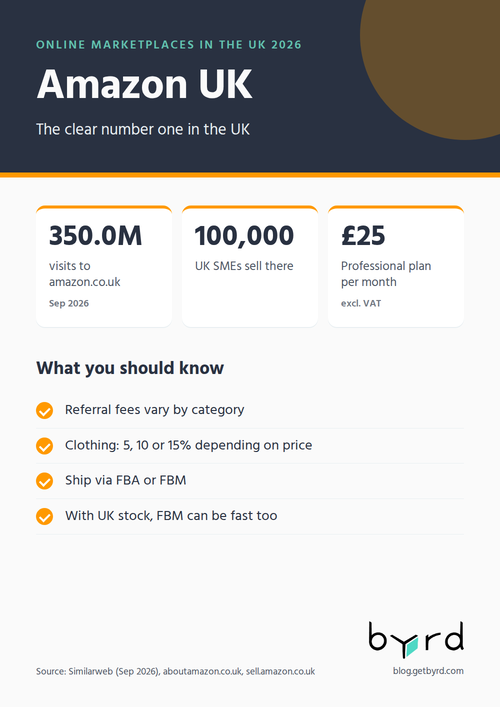
- Visits in September 2026: 350.0 million (amazon.co.uk)
- Product category: General
- Target region: Worldwide
It's no surprise that Amazon leads the UK e-commerce market, as it does in most Western countries. For third-party sellers, Amazon.co.uk is a huge channel: according to Amazon, around 100,000 UK small and medium-sized businesses sell on the marketplace, and their export sales alone came to £3.8 billion in 2024.
To sell, you usually need the Professional plan at £25 per month (excl. VAT). On top come category-specific referral fees, for clothing, for example, 5, 10 or 15% depending on the price (Amazon UK).
Amazon.co.uk is particularly suited to:
- FMCG, home & living, electronics, beauty, sports, pet supplies
- Brands with clear differentiation and enough margin for fees and ads
What you should know before you start:
- Amazon is highly competitive. Your success often depends on price, reviews, stock availability and delivery speed.
- Fulfillment can run via FBA or as Merchant Fulfilled (FBM), i.e. through your own warehouse or a 3PL. With stock in a UK warehouse, you can offer fast delivery with FBM too.
Logistics pro tip:
If you sell to the UK from abroad, the location of your stock determines delivery time, customs effort and return costs. With stock in the UK, you deliver as fast as a local retailer and can handle returns in the country instead of bringing them back across the Channel.
Top online marketplace in the UK #2: eBay UK
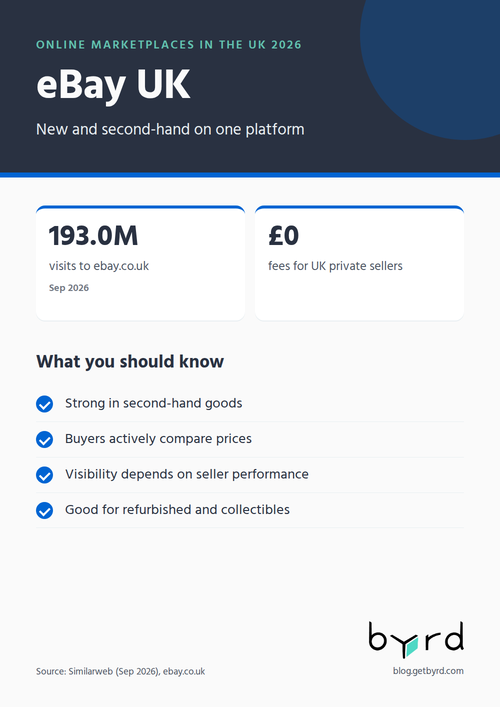
- Visits in September 2026: 193.0 million (ebay.co.uk)
- Product category: General
- Target region: Worldwide
eBay remains one of the biggest marketplaces in the UK, with a strong position in both new and second-hand goods and buyers who actively compare offers. For private sellers based in the UK, eBay.co.uk is free of selling fees (eBay). That brings plenty of supply and traffic, but for business sellers it also means more price comparison.
eBay UK is particularly suited to:
- Refurbished products, collectibles, hobby and specialist categories
- Competitively priced branded products
- Sellers with a broad assortment
What you should know before you start:
- Visibility on eBay is strongly influenced by seller performance, price, shipping speed and listing quality.
- eBay can be an effective channel for clearing stock without affecting how customers perceive the prices in your D2C shop.
Top online marketplace in the UK #3: Etsy
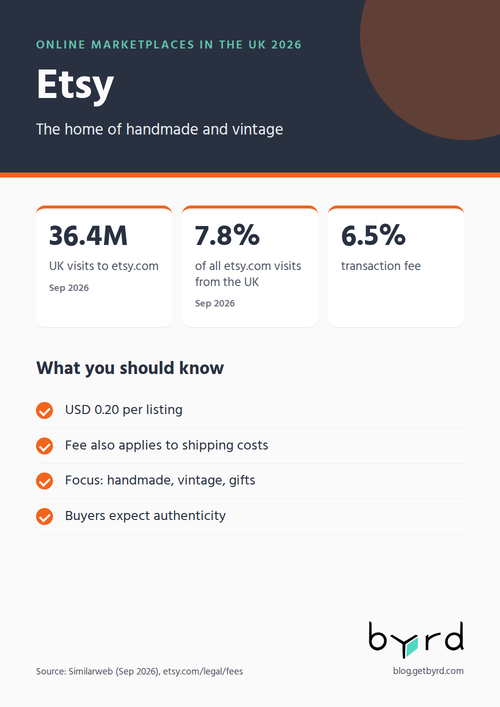
- Visits in September 2026: 36.4 million from the UK (7.8% of 465.8 million on etsy.com)
- Product category: Handmade products, vintage, gifts & art
- Target region: Worldwide
Etsy is part of the chasing pack behind Amazon and eBay, but it remains the go-to place for handmade, creative, vintage and personalized products where uniqueness matters more than the lowest price. Etsy charges USD 0.20 per listing and a 6.5% transaction fee on the sale price including shipping, plus payment processing fees that vary by country (Etsy).
Etsy is particularly suited to:
- Handmade, personalized products, print-on-demand used thoughtfully, vintage
- Brands with strong storytelling and clear differentiation
- Community-driven concepts
What you should know before you start:
- Etsy customers buy with clear intent, but they expect authenticity and detailed product information.
- Packaging and the unboxing experience can influence reviews more than you might think, especially in the gift segment.
Top online marketplace in the UK #4: ASOS
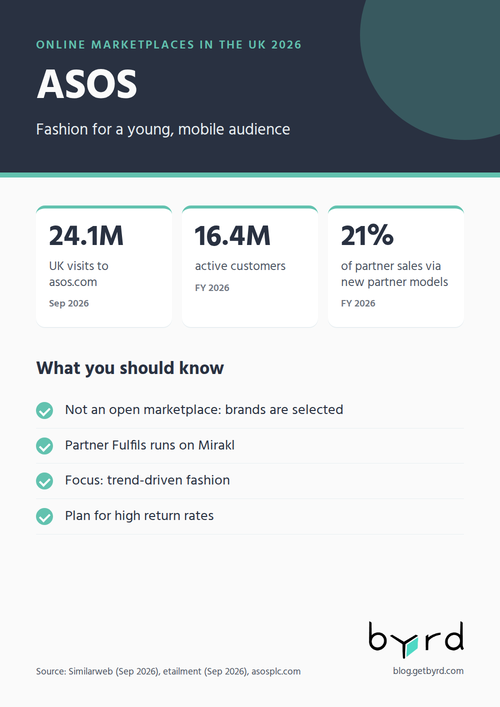
- Visits in September 2026: 24.1 million from the UK (32.9% of 73.4 million on asos.com)
- Product category: Fashion
- Target region: Global
ASOS is one of the UK's leading online fashion retailers and mainly targets young adults. In the financial year to the end of August 2026, ASOS had 16.4 million active customers, and gross merchandise value fell by 5%. At the same time, ASOS is relying more on partner stock: 21% of partner sales already run through models in which brands deliver themselves or ASOS manages their stock (etailment).
On the technical side, the "Partner Fulfils" program, in which brands ship directly to ASOS customers, runs on Mirakl. For you, this means: if ASOS accepts you as a partner, you need a fulfillment setup that can connect to Mirakl.
ASOS is particularly suited to:
- Fashion and accessories, especially trend-driven ranges
- Brands with a young audience and a mobile-first focus
What you should know before you start:
- ASOS isn't an open marketplace: brands are selected as partners.
- Fashion marketplaces often have high return rates. Your margins and processes should be built for that, for example with clear sizing, fast refunds and reliable delivery.
Top online marketplace in the UK #5: Wayfair
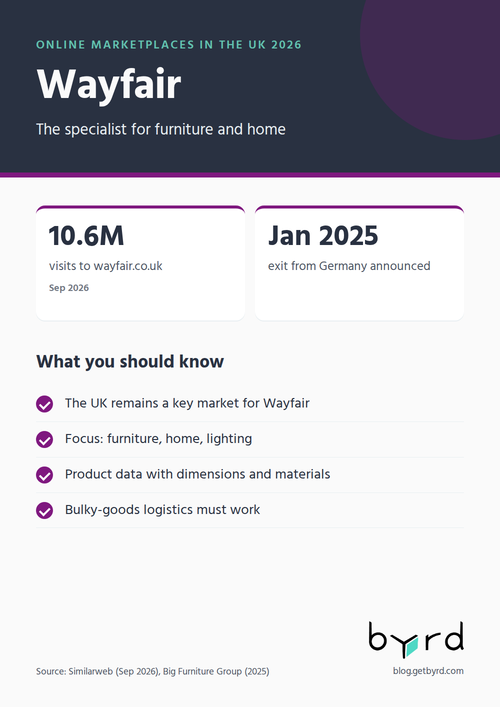
- Visits in September 2026: 10.6 million (wayfair.co.uk)
- Product category: Furniture and homeware
- Target region: North America & UK
Wayfair is one of the most important online retailers for furniture and home accessories in the UK. Worth knowing: Wayfair announced its exit from Germany in January 2025, but still describes its UK business as meaningful (Big Furniture Group). In Europe, that makes the UK the place to be for Wayfair.
In niche markets like this, customers are often one-off buyers with a higher basket value. That makes smooth delivery and assembly all the more important.
Wayfair is particularly suited to:
- Furniture, home accessories, textiles, lighting, DIY supplies
- Sellers with a stable supply chain and experience handling bulky goods
What you should know before you start:
- High-quality product data is essential: dimensions, materials, assembly information and images.
- The delivery experience is part of the product, especially for large and bulky items.
Top online marketplace in the UK #6: Zalando
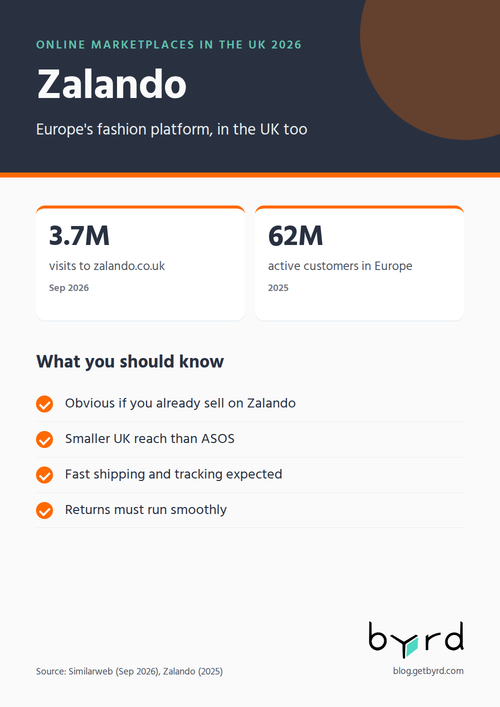
- Visits in September 2026: 3.7 million (zalando.co.uk)
- Product category: Fashion
- Target region: Europe
Zalando is one of Europe's most important fashion platforms and is also active in the UK with zalando.co.uk. Its UK reach is much smaller than ASOS's, but for brands that already sell on Zalando in other European countries, the UK shop is a natural extension.
Zalando is particularly suited to:
- Fashion and shoe brands with European ambitions
- Brands that can deliver marketplace-ready content and efficient returns management
What you should know before you start:
- Adapt your logistics to customer expectations: fast shipping, transparent tracking and smooth returns.
Top online marketplace in the UK #7: OnBuy
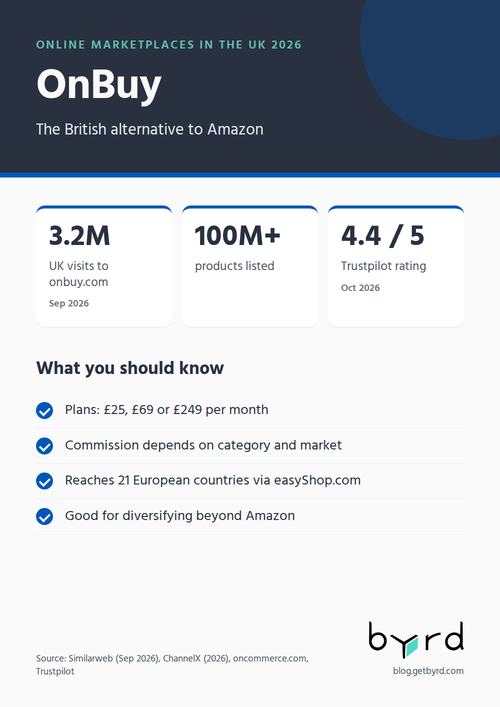
- Visits in September 2026: 3.2 million from the UK (63.1% of 5.1 million on onbuy.com)
- Product category: General
- Target region: UK and Europe
OnBuy started as a British alternative to Amazon and has become a relevant channel for sellers who want to reduce their dependence on Amazon or eBay. According to ChannelX, OnBuy has grown by more than 86% in three years and lists over 100 million products. In 2026, OnBuy and easyGroup also launched easyShop.com, a marketplace for 21 European countries.
Depending on the plan, sellers pay £25 (Standard), £69 (Partner) or £249 (Professional) per month, with the two higher plans reduced until January 2027. On top comes a commission on every sale that depends on category and market (OnBuy). OnBuy runs on the seller platform OnCommerce: with one account, you can also reach easyShop and Comet.
OnBuy is particularly suited to:
- Broad retail categories such as home, tech, beauty, toys and garden
- Sellers who want to diversify their marketplace strategy
- Buyers and sellers who deliberately want to support a British platform
What you should know before you start:
- As on any marketplace, strong product feeds and competitive delivery options win.
- Ideal as part of a portfolio strategy, for example Amazon plus one or two additional channels.
Is OnBuy legit? Many sellers and buyers ask this. On Trustpilot, OnBuy has a rating of 4.4 out of 5 from more than 135,000 reviews (as of October 2026). OnBuy is an established, regularly operated marketplace. As on any marketplace, though, you buy from individual sellers whose reviews you should check before buying.
Top online marketplace in the UK #8: ManoMano
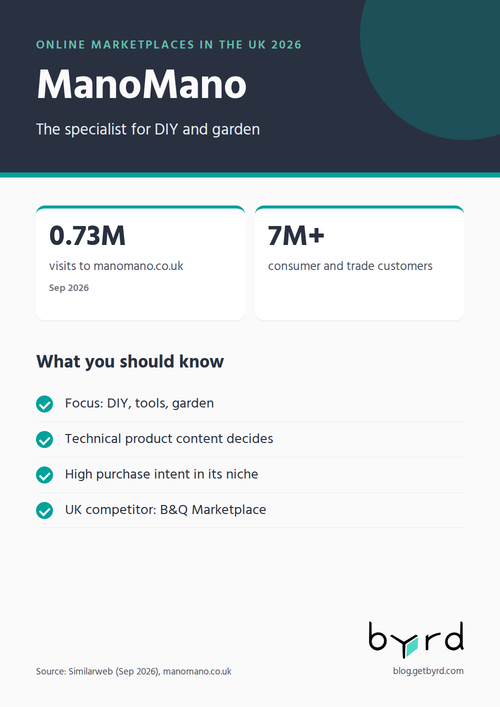
- Visits in September 2026: 0.73 million (manomano.co.uk)
- Product category: DIY, homeware, garden
- Target region: Europe
ManoMano focuses on DIY, home improvement and garden and is also present in the UK with manomano.co.uk. According to the company, the platform has more than 7 million consumer and trade customers. Compared to Amazon, ManoMano is a niche, but with a very purchase-ready audience in these categories.
ManoMano is particularly suited to:
- DIY, tools, garden, home improvement
- Sellers with deep product know-how and technical details
What you should know before you start:
- Content decides: technical specifications, compatibility, installation and usage information and Q&A-style product copy can noticeably influence conversion.
- In DIY, ManoMano isn't alone in the UK: B&Q also runs its own marketplace (see below).
More channels in the UK: TikTok Shop, Temu, Vinted, Argos and B&Q
Beyond the top 8, there are other channels in the UK that are growing fast, are new or can't be placed reliably in the ranking for lack of data. They're worth a look, especially if your assortment fits them.
TikTok Shop
TikTok Shop is far more than an experiment in the UK. According to ChannelX, more than 300,000 UK small and medium-sized businesses sell there, and sales via live shopping grew by 55% year on year. Beauty, fashion and lifestyle products that can be shown in short videos work particularly well. Before you start, check what requirements TikTok Shop UK sets for sellers based abroad.
Temu
Temu is also active in the UK and has quickly drawn a lot of attention with an aggressive pricing strategy and high product visibility. Our data doesn't allow a reliable statement on how many visits to temu.com come from the UK, which is why Temu isn't in the ranking. For sellers who can compete on price, Temu can be an additional channel. But check your brand positioning carefully: for premium or strongly values-driven brands, the heavily price-driven platform isn't always the best choice.
Vinted
For second-hand fashion, Vinted has become one of the most important platforms in the UK. According to Business Matters, Vinted has more than 16 million registered users there, and the UK is its second-largest market after France. With Vinted Pro, businesses can sell too, but according to Vinted, Vinted Pro is currently only open to companies from Italy, the Netherlands, France, Spain, Portugal, Luxembourg, Belgium and the UK. By the way: Vinted is one of byrd's valued customers.
Argos Marketplace
One of the best-known UK retailers is opening up its platform: Argos launched its marketplace in August 2026, initially with almost 80 brands and retailers (ChannelX). The marketplace runs on Mirakl, and sellers can apply as partners. For home, toys and electronics ranges, that makes Argos a channel to keep an eye on.
B&Q Marketplace
DIY chain B&Q also runs a Mirakl-based marketplace and has been accepting sellers from Germany since November 2025, alongside Ireland, Italy, Poland, the Netherlands and Spain. Gross merchandise value reached £228 million in the half-year, up 45.4%, and there are no listing fees (ChannelX). For DIY, garden and home ranges, B&Q is a real alternative to ManoMano and Amazon.
Mirakl: one connection, many marketplaces
- ASOS, Argos and B&Q all use Mirakl's marketplace technology.
- byrd is integrated directly with Mirakl. Orders from Mirakl marketplaces flow automatically into your warehouse, and tracking data goes back to the marketplace. Find out more on our Mirakl fulfillment page.
Alternative or addition to online marketplaces in the UK
Marketplaces are a good way to grow e-commerce sales or expand into new e-commerce markets. Running your own online shop, however, has many advantages over selling on marketplaces.
Some of these advantages are:
- The chance to build your brand deliberately
- Customizable packaging and unboxing experience
- Clear positioning on sustainability
- Less dependence
- More flexible cost structure
- Easier customer retention
- Better differentiation from competitors to avoid price wars
- Direct contact and feedback from your customers
- More data
- More control over your processes
Most successful brands combine both: their own shop with prices in pounds as the base and two or three marketplaces for additional reach.
Selling on the top UK marketplaces: shipping and logistics are crucial
Whichever marketplaces you sell on, a large part of your success depends on your logistics.
Customers expect fast shipping, transparent tracking and easy returns, especially when buying on marketplaces. Because marketplaces are built for quick price and offer comparison, delivery speed and shipping costs have a big influence on your conversion. Amazon has shaped expectations of fast delivery enormously, and many marketplaces keep tightening their rules on shipping and delivery times.
For sellers from the EU, Brexit adds another layer: every shipment from the EU is an export with customs clearance. That's exactly why a well-thought-out setup makes a real difference:
- Store your goods close to your customers, i.e. in the UK
- Ship with established local parcel carriers in the UK
- Offer fast and competitive delivery options
- Handle returns locally wherever possible
With byrd, you store your stock in our fulfillment network in the UK and serve all your channels from there. Orders from Amazon (FBM), eBay, Zalando and Wayfair can be connected to byrd, as can Mirakl marketplaces such as B&Q, and they run through the same warehouse together with orders from your own shop. We ship with Royal Mail, DPD and Parcelforce. Orders received before the cut-off leave the warehouse the same day, and with next-day shipping they reach your customers the next day. You decide which products you sell on which marketplace, and you can see stock, orders, shipments and returns at any time in one dashboard.
And because byrd also runs warehouses in Germany, France and Austria, you can manage the UK and the EU from one system. If you have other markets in mind, our overviews of online marketplaces in Germany, France, Poland and the Netherlands will help.
Frequently asked questions about online marketplaces in the UK
What is the biggest online marketplace in the UK?
Amazon.co.uk, with around 350 million visits in September 2026, well ahead of eBay.co.uk with around 193 million. According to Amazon, around 100,000 UK SMEs sell on the marketplace.
Is OnBuy legit?
Yes. OnBuy is an established British marketplace with over 100 million products and a Trustpilot rating of 4.4 out of 5 from more than 135,000 reviews (as of October 2026). As on any marketplace, you buy from individual sellers whose reviews you should check.
Can I sell on UK marketplaces from outside the UK?
Yes, big marketplaces such as Amazon.co.uk, eBay.co.uk and B&Q accept sellers from the EU. You need an EORI number and have to take care of UK VAT: for consignments up to £135 shipped from abroad, the marketplace accounts for the VAT. If you store goods in the UK, you need your own UK VAT registration.
Do I need UKCA marking to sell in the UK?
Not for most products. CE marking is still recognized in Great Britain, and UKCA is an alternative.
How much does it cost to sell on Amazon UK?
The Professional plan costs £25 per month excl. VAT. On top come category-specific referral fees per item sold and, if you use FBA, fulfillment and storage fees.