
Every range has them. Products that were a good idea two years ago, have sat on the shelf ever since and do three things: rack up storage costs, tie up capital and eat time at every stocktake. The problem with slow movers is not that they exist. The problem is that they are invisible: no dashboard raises an alarm for a product that simply does nothing.
The slow-mover report from byrdAI makes exactly these silent products visible, sorted by the capital they tie up. And it answers the question that comes next: what to do with them?
The problem: nobody notices doing nothing
Slow movers set off no alarm. A stockout hurts straight away, a wave of returns too. A product that has not been ordered in 14 months does nothing at all, and that is exactly why nobody deals with it.
The costs are hidden but real. Every occupied storage location costs you money every month. On top of that comes the tied-up capital: goods you have paid for that never turn back into revenue while they sit there.
Gut feeling deceives. Asked about their slow movers, most merchants name two or three suspects. The report regularly shows considerably more, up to several times as many. That often includes products that have never seen a single order.
How to find your slow movers with byrdAI
Once connected, a question like this is all it takes in Claude or ChatGPT:
"Which products have not moved in the last 90 days?"
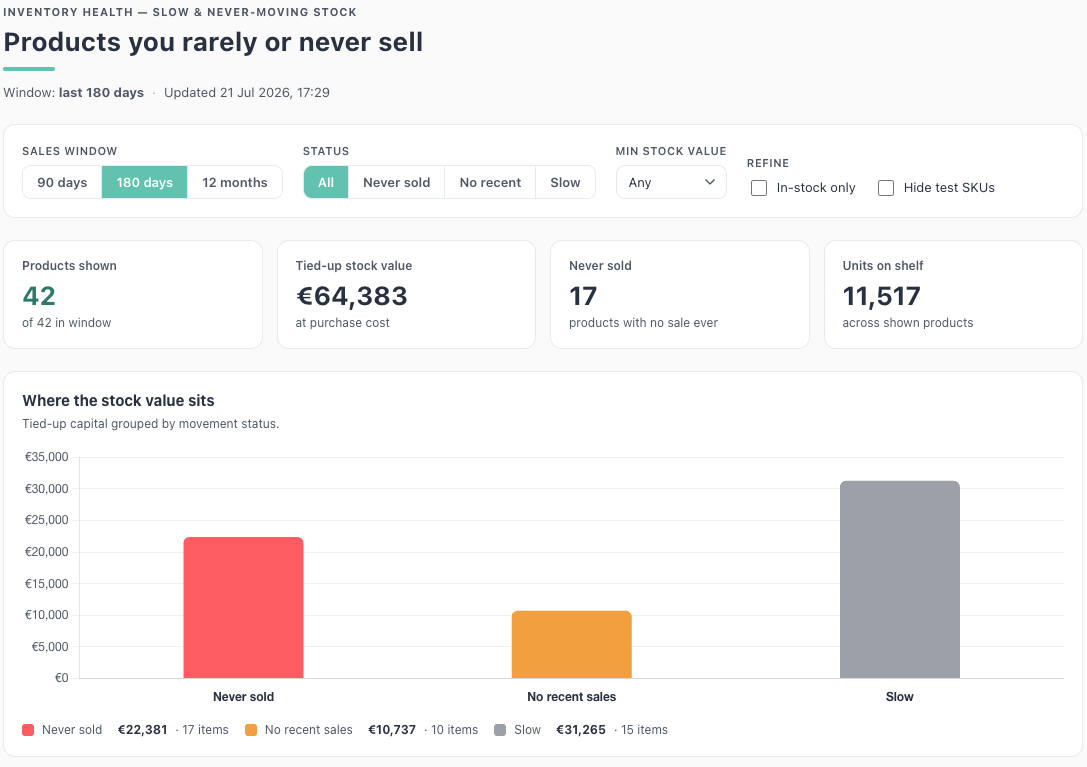
byrdAI pulls your live data from byrd and returns every affected product with status, stock, last dispatch date and tied-up stock value. With the ready-made dashboard prompt from the byrdAI page, that becomes a live dashboard that splits your silent products into three honest categories:
- Never sold: not a single order since it was created. The hardest cases and usually the clearest decisions.
- Not sold for a long time: ordered in the past, dead for months. Here it is worth looking at the cause: price, visibility, season?
- Slow: it trickles. Five sales in six months rarely justifies its own storage location.
Which decisions to draw from it
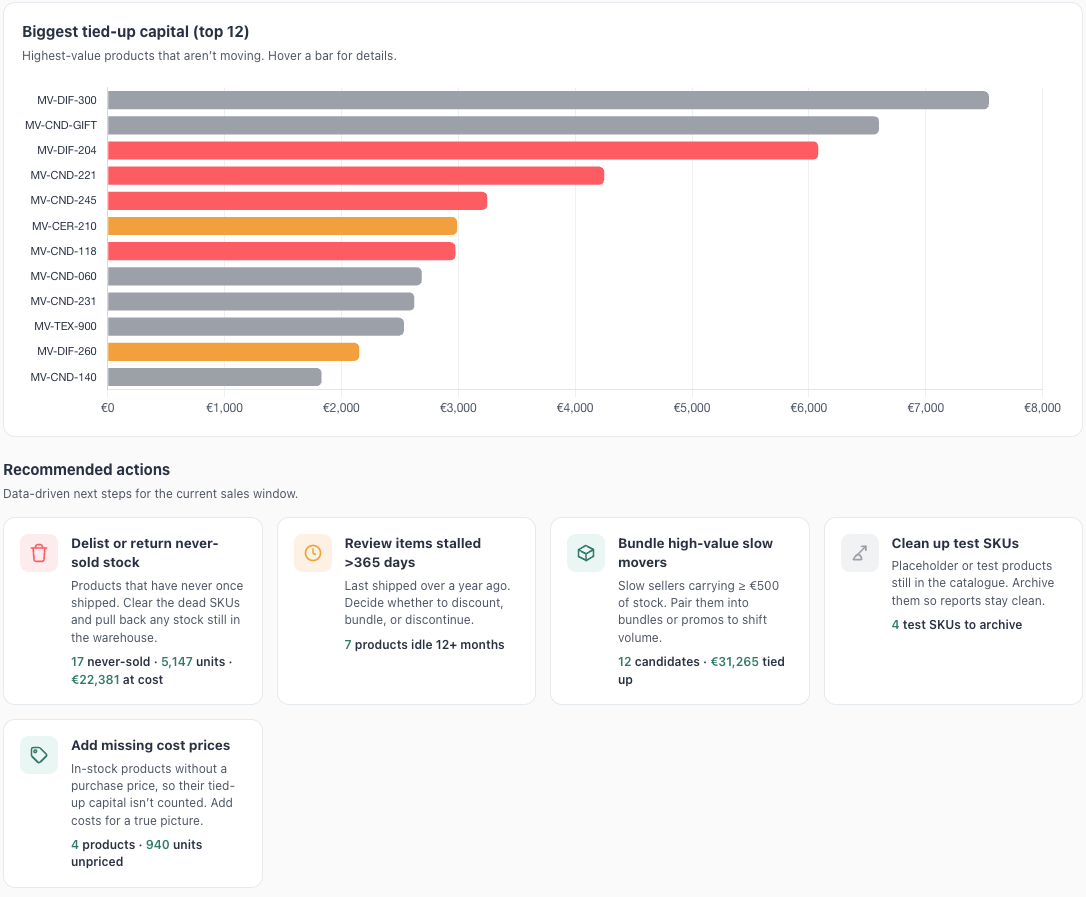
Never-sellers: out.
Back to the supplier, donate, write off or use as a free add-on. Anything beats another twelve months of storage costs for a product without a single buyer.
High-value slow movers: activate rather than write off.
Products with a meaningful stock value belong in a bundle with a bestseller, a discount campaign or a marketplace deal. Your ABC analysis shows you which A-items are suitable as the workhorse for the bundle.
Clear out the rest decisively.
Range cleanup is not an admission, it is hygiene: fewer SKUs mean fewer storage locations, less counting effort and more focus on the products that carry your business.
The quarterly review.
"On the first Monday of every quarter, create the slow-mover list for me, sorted by tied-up capital, with a recommendation per product: sell off, bundle or delist." An unpleasant ad-hoc project becomes a 20-minute routine.
The bundle suggestion.
"For my 10 most valuable slow movers, suggest a bundle each with a matching bestseller, including a price suggestion." The assistant combines the slow-mover report and top-mover data in one answer.
The new-product watchdog.
"Let me know when a product still has fewer than 5 sales 120 days after being created." That is how you spot flops early, while the stock is still small and the problem still cheap.
The sell-off campaign.
With a follow-up prompt, the list turns straight into a campaign draft: affected products, remaining stock, recommended discount, copy block for the newsletter.
Make the silent products visible
As a byrd customer, you connect byrdAI to Claude or ChatGPT in around 5 minutes and copy the slow-mover prompt from our byrdAI page or below this section. Not a byrd customer yet? byrdAI comes only with byrd fulfilment, as the first European 3PL with an MCP server. Talk to us.
Example prompt for the slow-mover report (adjust it however you like).
Häufige Fragen zum Ladenhüter-Report mit byrdAI
When does a product count as a slow mover?
The report uses as its default: at most 5 units sold in the chosen period (90, 180 or 365 days). You can freely adjust the threshold by prompt.
What is the difference from the overstock report?
The slow-mover report finds products that barely or never sell, a demand problem. The overstock report finds products that sell well but of which far too much is in the warehouse, a purchasing problem. Together, both show you all of your tied-up capital.
What does byrdAI cost?
During the beta, byrdAI is included free in your account for byrd customers.